1
Introduction to the Profession
Meet the dental health team — dentists, hygienists, front- and back-office personnel — and their responsibilities.
Get started with no surprises. Covering basic dentistry, healthcare ethics, office management, sedation techniques, and more — combining classroom instruction with clinical training to satisfy Florida's certification hour requirements.
Everything you need to know to excel — from the fundamentals of dentistry to office management and resume preparation.
Meet the dental health team — dentists, hygienists, front- and back-office personnel — and their responsibilities.
Ethics governing dentistry, regulating agencies, licensure procedures, and credentialing.
Preventing the spread of disease — agencies, guidelines, PPE, and safe waste handling.
Basic principles of X-Ray, machine operation, film exposures, and processing errors.
Form and structures of natural teeth, plus the Universal Numbering System for permanent and primary teeth.
Enamel, dentin, cementum, the periodontal ligament, gingiva, anatomical landmarks, and dental terminology.
Diseases of oral structures and how to distinguish normal from abnormal conditions.
Anatomy of the mouth, salivary glands, and common oral lesions.
Cavity varnishes, liners, cements, periodontal dressings, sealants, composites, and amalgams.
Special requirements when treating children, informed consent, behavior management, and common pediatric procedures.
Restoring or replacing one or more teeth with various types of fixed prosthodontics.
Root canal therapy — the steps, instruments, and materials involved.
Properties of anesthesia and when and where they are used in dental treatment.
Causes and types of malformations and malocclusions, and how they're corrected.
Causes, symptoms, examination, and treatment of periodontal disease — the most common cause of tooth loss.
Extractions, jaw fractures, grafts, tumor and cyst removal, and reconstructive procedures.
How to respond to medical emergencies and the risks of providing dental care.
Reception, record keeping, patient scheduling, and general office management.
Daily, weekly, monthly, and annual upkeep on dental equipment.
The dos and don'ts of crafting a resume that lands you the job you want.
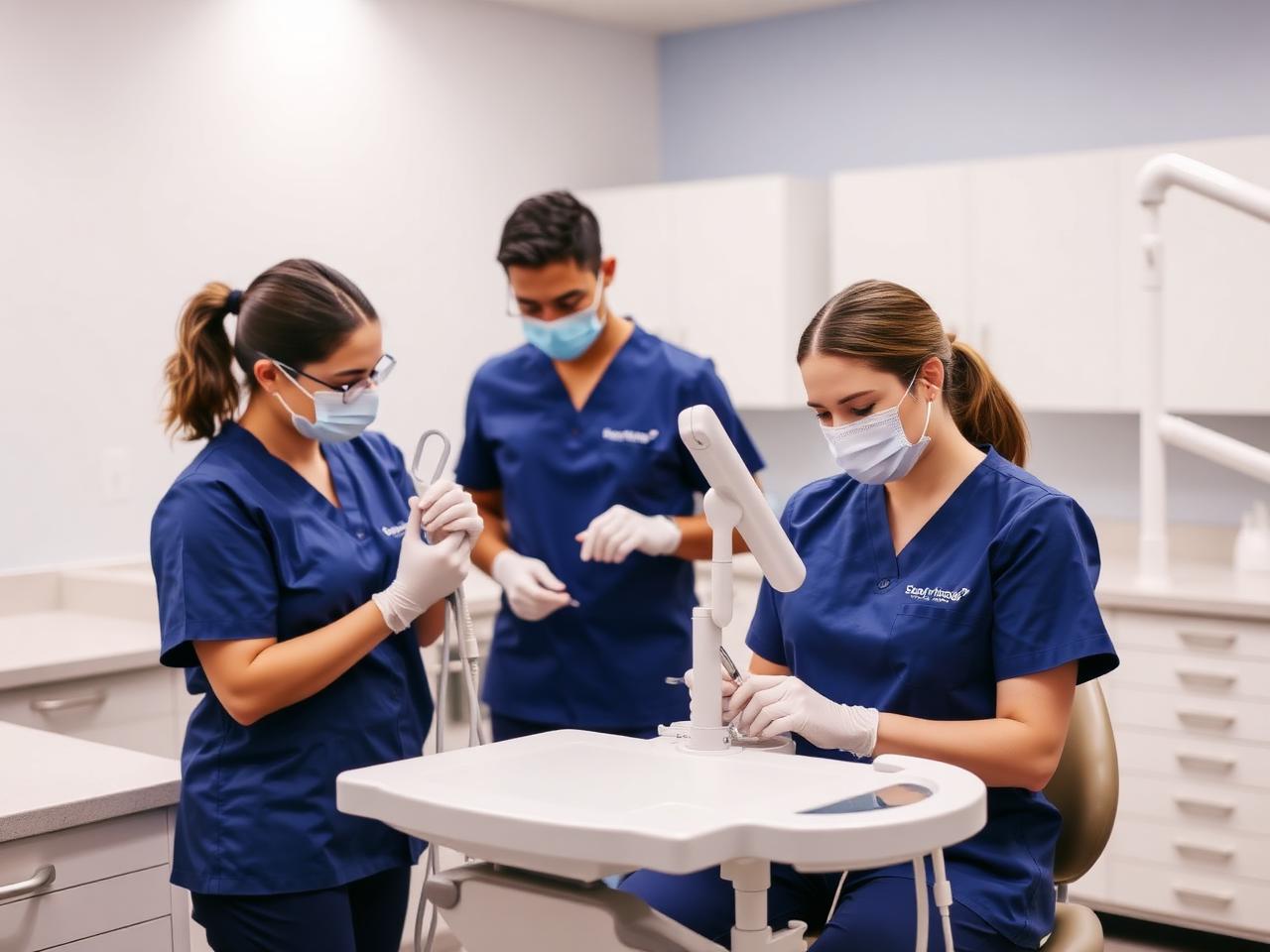
Under supervision, students learn and practice placing topical anesthesia, monitoring nitrous oxide, and assisting in X-rays — under a licensed dentist's full responsibility.
Operating the dental chair and equipment; OSHA standards and donning PPE in the clinic.
Keeping the field clean and accessible; organizing and trayed-up instruments.
Pre- and post-treatment procedures using CDC infection-control guidelines and safe instrument transfer.
Basic X-ray techniques, full-mouth series, developing and mounting radiographs.
Documenting dental conditions and services using standard symbols, abbreviations, and Black Cavity Classifications.
Taking accurate 3D impressions of teeth and tissues using alginate, silicone, and gypsum.
Bonding agents, restoration prep, plus amalgam and composite resin restoration video review.
Pulpotomy and stainless crown setup, ZOE base, and permanent cement mixing.
Fabrication and installation of complete and partial dentures with tray set-up practice.
Expelling impression materials and fabricating and adjusting temporaries.
Root canal procedures, materials, instruments, and rubber dam placement on the typodont.
Loading syringes, proper passing, and safe recapping techniques.
Applying dental sealants and related teeth-whitening techniques.
Sealing, prophylaxis, ultrasonic scaler assembly, and coronal polishing demonstrations.
Instruments for routine extraction and proper instrument-passing order over a patient.
American Red Cross / Fire Department-led CPR training. Certificate included with tuition.
After completing all labs and lectures, you'll undergo a course review, practical, and final exams before graduating. The program ends with a 50-hour externship at a local dental practice.
Reserve your seat in the next class with a refundable $500 deposit.